
Challenge Recap
Sticky Date Pudding with Miso Butterscotch Recap
Aug 13, 2026 · 2 min read
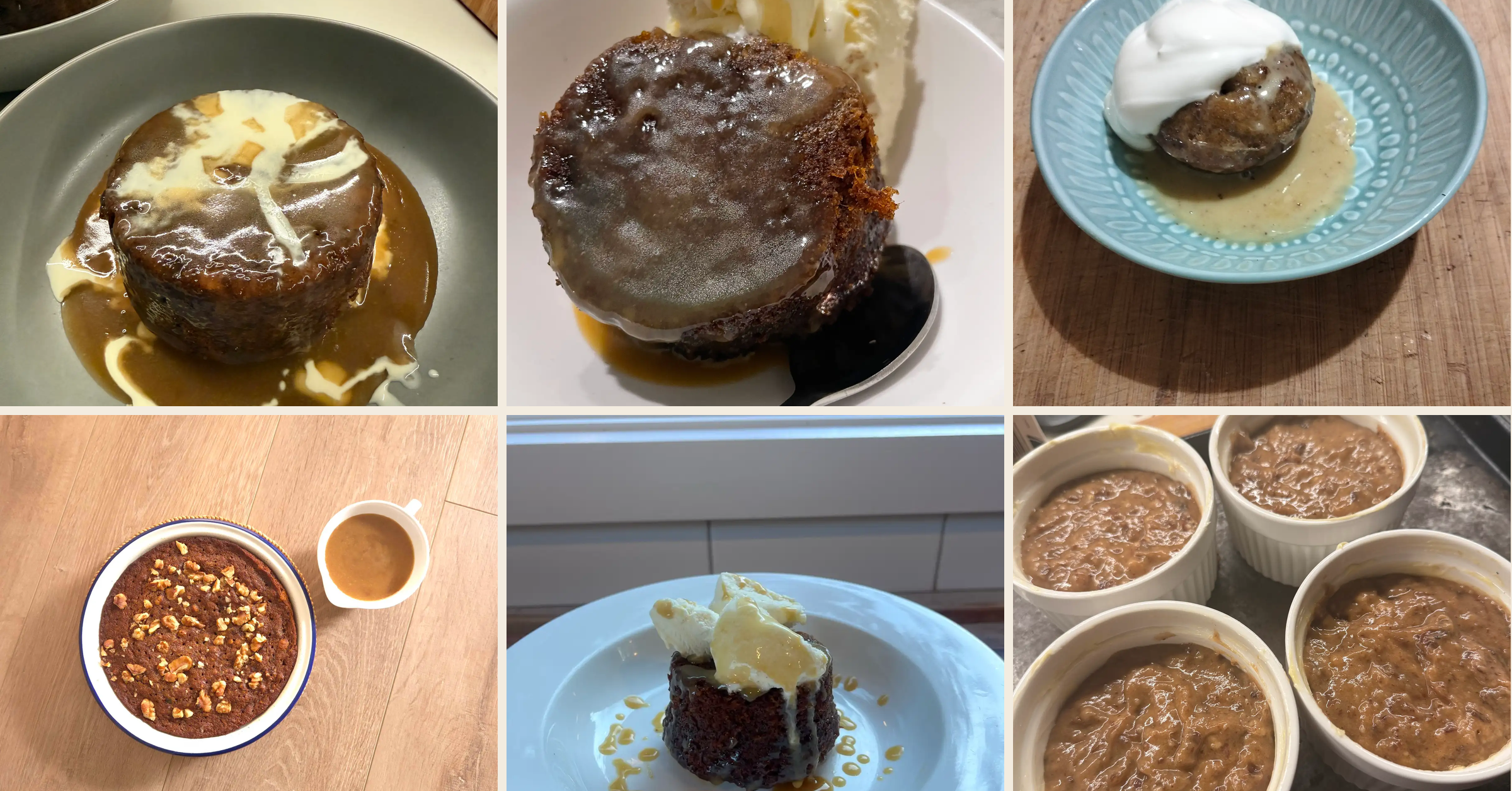
Six puddings came back and no two were the same. Here is what the week looked like from the spoon.
Week 9 was sticky date pudding: dates softened with bicarb and boiling water, mashed into the batter, baked in ramekins, then poked and soaked with a butterscotch seasoned with white miso instead of salt. Six puddings came back, from the same six of us who cooked gnocchi the week before. It is the first time the whole group has gone back to back.
Everyone made it their own
Making the recipe your own is half the point of this thing, and this was the week the group really ran with it. One cook halved the sugar in the sauce and reckoned it lost nothing. One went greek yoghurt and tahini on top. There was peanut butter on another plate, crushed walnuts on a third, ice cream on a fourth, and one cook scaled the whole thing down to a half batch in a pie dish. Six puddings, no two alike.
To be straight about what drove some of it: the butterscotch is rich at full strength, and something sharp, salty or cold next to it is a genuine upgrade. The fix list below writes that in.
“Using miso in place of salt for the butterscotch felt like an upgrade to salted caramel. Whilst delicious, it felt like it overpowered the pudding, which was enjoyable on its own.”
The bake time was the other problem
It missed in both directions. One cook found the puddings took a lot longer than we said, and got there by trusting the skewer over the timer, which is exactly the tip we wrote. Another checked at the stated time, saw raw middles, gave them a little longer and overshot.
What we would fix in the recipe
- Give a check time and a window, not one bake time. Two of us missed the single number in opposite directions.
- Say it halves. A pie dish and half the batter bakes in roughly the same time.
- Write the toppings in. Four different plates arrived with one, and the recipe suggested none.
Two more stay on the watch list rather than the fix list. Less sugar in the sauce: one cook halved it and was happy, one said they would cut back next time. And the miso ceiling: one cook found two tablespoons too much, two others loved the sauce as written. One or two votes out of six is not enough to change a recipe, so both wait for the next time we cook it.
average rating from 3 cooks
What you keep
Butterscotch, first. Brown sugar, butter and cream in a pan is three ingredients and about eight minutes, and it keeps a fortnight in a jar in the fridge. It goes on ice cream and pancakes. The second keeper is the seasoning idea underneath the miso. Salted caramel works because salt holds the sweetness down. Miso does the same job with more depth, and once you have tasted that you will start reaching for it in other sweet things.
The recipe
Sticky Date Pudding with Miso Butterscotch
40/80 min active/total · Serves 6 · 6 steps
Ingredients
Method
- 01
Soak and mash the dates
The dates are the sponge. Soften them until they collapse into a thick, wet mash.
Heat the oven to 180°C / 160°C fan. Butter six ramekins generously, right up the sides, and sit them on a baking tray. Butter a spare one or two as well if yours run small.
Roughly chop the 300 g of pitted dates into a heatproof bowl. Scatter the 1 tsp of bicarb soda over the top, then pour on the 250 ml of boiling water. The bicarb soda breaks the dates down and gives the sponge its dark colour.
Stand for 10 min, or up to 20 if your dates were dry and firm out of the packet, then mash hard with a potato masher until it is a thick, wet mash with no whole pieces left.
Leave it to cool while you build the batter. It needs to come down to barely warm.
- 02
Build the batter
A quick whisked batter, then the date mash folded through at the end.
Whisk the 90 g of melted butter with the 110 g of brown sugar, the eggs and the vanilla in a large mixing bowl until smooth, about 1 min. No mixer needed.
Whisk in the cooled date mash until even.
Add the 180 g of plain flour, sprinkle the 1 tsp of baking powder and the salt evenly over the top, and fold just until the flour disappears. It will be a loose brown batter, closer to a thick pancake batter than a cake one. Stop the moment it is mixed.
- 03
Fill and bake
Two-thirds full, no higher. These rise more than you expect.
Divide the batter between the ramekins, filling each about two-thirds. No higher, this batter rises well and will spill over a full ramekin. If there is batter left over, fill a spare ramekin rather than topping up the others. Depending on the size of your ramekins this batch makes six to eight.
Bake for 25 to 35 min, checking from 22. Ovens and ramekins vary a lot here, so trust the skewer over the clock. They are done when the tops spring back from a light press and a skewer pushed into the middle comes out clean or with a couple of moist crumbs.
While they bake, get the sauce going. When they come out of the oven, leave them sitting in their ramekins. Do not turn them out yet.
- 04
Make the miso butterscotch
A glossy brown sugar butterscotch, seasoned with white miso instead of plain salt.
Spoon the 2 tbsp of white miso into a small bowl and whisk in a splash of the cream until it is a smooth slurry. Dropped straight into hot sauce, miso stays in stubborn little beads.
Put the 180 g of brown sugar, the rest of the 300 ml of cream, the 60 g of butter and the vanilla in a saucepan over medium heat. Stir until the butter has melted and the sugar no longer feels gritty on a spoon.
Whisk in the miso slurry and let it bubble at a lazy simmer for 2 to 3 min, stirring, until it turns glossy and coats the back of a spoon. Never a rolling boil. Boiled hard, it splits and goes greasy.
Taste it with a scrap of sponge rather than on its own. You are after a savoury depth behind the caramel, not anything you would pick as miso.
- 05
Poke and soak, in the moulds
The step that makes it sticky. Both the sponge and the sauce need to be hot.
Leave the puddings in their ramekins and poke a dozen holes into each one with a skewer, pushing right down to the base and wiggling slightly so the holes stay open.
Spoon a generous tbsp or two of the hot butterscotch over each and leave them to drink it in for 10 min. The surface will darken and go glossy as the sauce works down through the holes.
They will not go cold. The ramekins hold their heat, and the rest firms them up so they turn out cleanly instead of tearing.
Keep the rest of the sauce warm on the lowest heat. If it stiffens as it cools, loosen it with a splash of cream.
- 06
Turn out and pour at the table
Hot sponge against cold ice cream, and the sauce poured in front of everyone.
Run a small knife around the inside of each ramekin, put a shallow bowl on top and flip it. A firm tap on the base releases a stuck pudding. The soaked face ends up underneath, sitting in its own sauce.
Add a scoop of vanilla ice cream or a pour of cold cream next to each one, then bring the pan of warm butterscotch to the table and pour it over in front of everyone. Finish with a small pinch of flaky salt if you want the edges sharper.
Eat straight away, while the sponge is hot and the ice cream is cold. That contrast is most of the pleasure.